Living With Animals, Living With Beauty: The Complete Rug Guide for Pet Owners
Approximately two-thirds of American households include at least one pet. And yet the interior design conversation around rugs continues to treat animal cohabitation as an afterthought—a footnote addressed with a vague recommendation to seek out "stain-resistant" options and move on. For anyone who has watched a light-colored wool rug absorb a muddy paw print in real time, that advice lands as spectacularly insufficient.
The truth is that choosing a rug for a home with pets is a genuinely nuanced design decision—one that involves fiber science, weave structure, color theory, and maintenance strategy in equal measure. Done thoughtfully, it need not result in the utilitarian, aesthetically compromised spaces that pet owners are so often told to accept. Done carelessly, even the most expensive rug becomes a liability.
Understanding What Pets Actually Do to Rugs
Before evaluating materials, it helps to be precise about the mechanisms of damage. Pets affect rugs through four primary vectors: abrasion from claws and nails, moisture from accidents and wet paws, embedded particulate from shedding fur and tracked debris, and odor absorption into pile fibers.
Not all of these are equally difficult to address, and not all rugs fail in the same ways. A rug that handles moisture poorly may perform beautifully under a cat with no accident history. A rug that traps fur relentlessly may be perfectly adequate in a home with a short-haired dog and a good vacuum. Understanding which of these factors is most relevant to your household is the first step toward a genuinely useful purchasing decision.
Natural Fibers: An Honest Assessment
Wool is the fiber most frequently recommended by interior designers, and for many good reasons. It is naturally soil-resistant due to the lanolin present in its fibers, it recovers well from compression, and it offers a visual richness that synthetic alternatives rarely replicate convincingly. For pet households, wool performs reliably against dry soil and light abrasion. Its limitation is moisture: wool absorbs liquid readily and, if not treated promptly, can develop mildew and permanent staining. For homes with dogs prone to accidents or cats who occasionally miss their litter boxes, untreated wool requires careful management.
Some wool rugs are treated with stain-resistant finishes at the manufacturing stage, which substantially improves their moisture performance. If wool is your preference, this treatment is worth seeking out explicitly rather than assuming its presence.
Cotton flatweaves present a different profile. They are lighter, often machine-washable, and easy to dry—qualities that make them genuinely practical for high-incident households. Their limitation is durability: cotton pile wears faster than wool under claw abrasion and loses its appearance more quickly in high-traffic zones. As a kitchen or mudroom rug in a dog household, a washable cotton flatweave is an excellent choice. As a primary living room anchor, its longevity may disappoint.
Natural plant fibers—jute, sisal, and seagrass—are frequently positioned as pet-friendly due to their durability and neutral tones. Sisal in particular is highly resistant to claw abrasion. However, all three absorb moisture aggressively and are extremely difficult to clean once stained. They are best reserved for lower-risk placements: a study, a formal dining room, or a bedroom with limited animal access.
The Case for Synthetic Fibers
The interior design industry has historically treated synthetic rugs as a concession—a category for homeowners who cannot afford better. That characterization deserves revision, particularly in the context of pet households.
Modern polypropylene rugs, often marketed under brand names like Surya, Nourison, or Loloi's performance lines, have advanced considerably in visual sophistication. Many are now produced with pile structures and colorways that convincingly approximate the depth of natural fiber rugs at a fraction of the maintenance burden. Polypropylene does not absorb moisture, resists most common stains when treated promptly, and can be cleaned with mild soap and water without fiber damage. For households with young dogs still in training or cats with occasional health-related accidents, this profile is genuinely compelling.
Nylon offers similar moisture resistance with greater pile resilience and a softer hand feel than polypropylene. It is the fiber of choice for many commercial-grade rugs and holds up exceptionally well to repeated cleaning. Its cost sits between polypropylene and wool, and its aesthetic range has expanded significantly as manufacturers have responded to consumer demand for more design-forward options.
Polyester blends occupy a middle ground—softer underfoot than polypropylene, more affordable than nylon, and reasonably moisture-resistant. Their weakness is pilling under heavy claw abrasion, which can become visible over time in frequently trafficked areas.
Color and Pattern Strategy
Material selection is only half the equation. Color and pattern choices have a dramatic effect on how a rug performs visually over time in a pet household.
Solid light-colored rugs are the most unforgiving option available. Every piece of fur, every tracked-in particle, every faint paw impression reads clearly against a uniform pale field. If a light aesthetic is important to your space, a low-contrast pattern—subtle tone-on-tone texture, a faded vintage print, or a heathered multi-strand construction—will disguise the inevitable accumulation of daily life far more effectively than a solid equivalent.
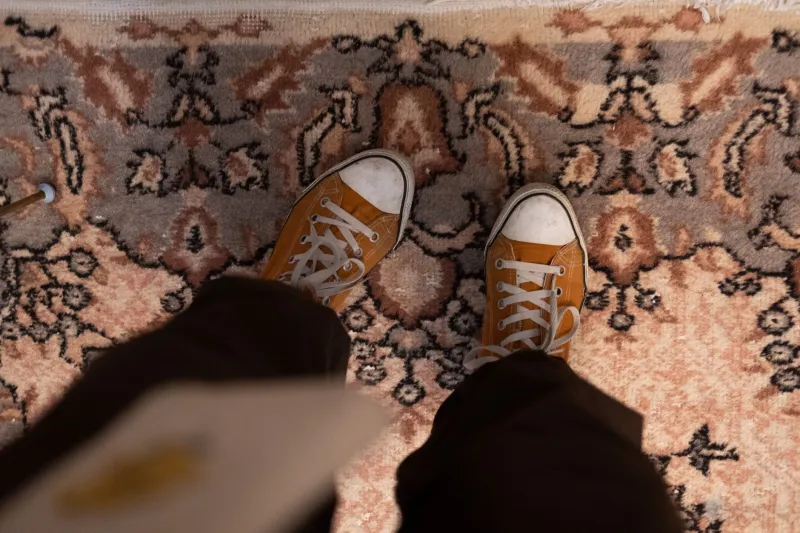
Mid-toned rugs in warm earth ranges—terracotta, ochre, sand, soft brown—are among the most practical choices available, because they approximate the color of most common soils and pet fur. A warm-toned, multi-hued flatweave or low-pile wool in this range can look impeccable even when it genuinely needs vacuuming.
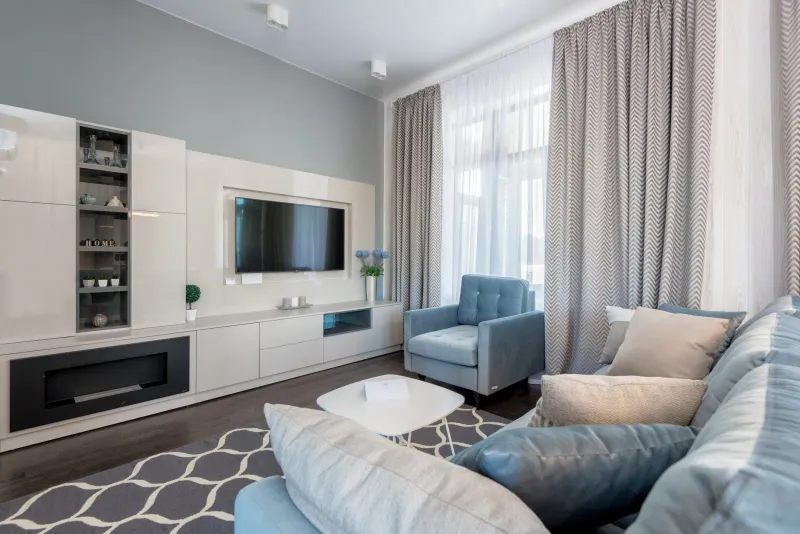
High-contrast patterns—bold geometrics, stark black-and-white designs—are visually striking but tend to show fur and light debris prominently against their darker fields. If you love this aesthetic, plan for more frequent maintenance.
Maintenance as Design Strategy
The most durable rug in the world underperforms without consistent care. For pet households, a maintenance routine is not optional—it is the mechanism that preserves both the rug's function and its appearance.
Frequent vacuuming, ideally two to three times per week in high-traffic zones, prevents particulate from working its way into pile fibers where it becomes abrasive. Prompt treatment of any moisture event—blotting rather than rubbing, followed by appropriate spot cleaning with a pH-neutral cleaner—prevents staining from setting. Annual professional cleaning extends the life of any rug significantly and addresses odor absorption that household cleaning cannot fully resolve.
For households where accidents are a recurring reality, a removable rug pad with a moisture barrier between the rug and the floor surface is a practical investment that protects both the rug backing and the floor beneath.
The Beautiful and the Resilient Are Not Opposites
The assumption that pet owners must choose between a home that looks designed and a home that functions for animals is one worth retiring. The American rug market now offers sufficient range—in fiber, construction, pattern, and price—to accommodate both priorities without significant compromise. The key is approaching the selection process with the same specificity that the question demands: knowing your animals, knowing your household patterns, and matching those realities to materials and maintenance strategies that can genuinely meet them.