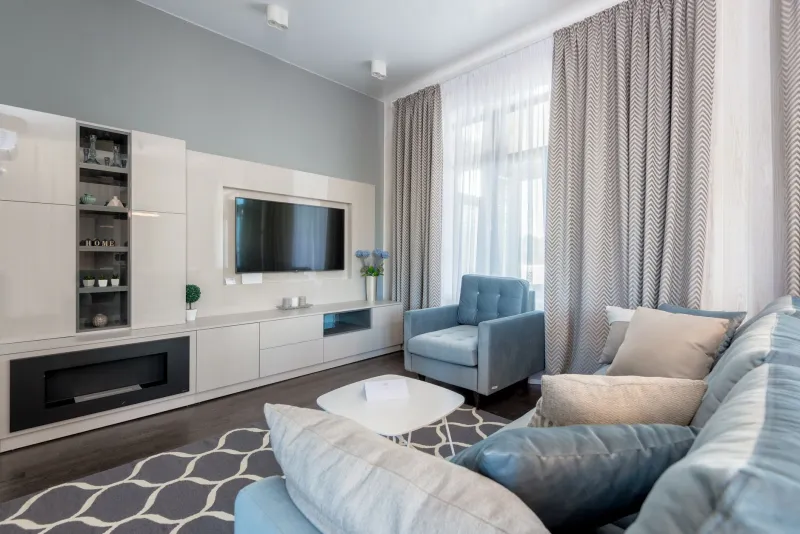
Five Rugs, One Home: The Smart Buying Order for New Homeowners

Photo: Doug Wilson, Public domain, via Wikimedia Commons
The first year in a new home is a sequence of purchases made under pressure, and rugs are among the easiest to get wrong. Rooms all look unfinished at once, so buyers tend to spread a fixed budget thinly across every floor, ending up with five rugs that are each slightly too small. A better approach is to buy in order of impact: the rooms where a rug changes daily experience most, funded first and funded properly.
What follows is a starter sequence for a typical American home, assuming a household furnishing two to three bedrooms and a main living level over the first twelve to eighteen months.
1. The entryway
Why first. The entry is the most trafficked square footage in the house and the first thing every visitor sees. It is also the least expensive place to buy well: a runner of reasonable quality costs a fraction of a living room rug, making it the highest-confidence purchase on the list.
Sizing. Measure the clear floor between the door swing and the first wall or stair. Standard runners run roughly two and a half by eight feet, two and a half by ten, and three by twelve. Leave six to twelve inches of visible floor at each end so the rug reads as intentional rather than wall-to-wall.
Material. Choose low pile and cleanable: wool flatweave, a wool-polypropylene blend, or a washable cotton flatweave if the household includes pets, children, or a wet climate. Avoid long pile here; it holds road salt, grit, and moisture.
Pad. A thin, non-slip pad. This rug will shift more than any other in the house.
2. The living room
Why second. This is where the rug budget earns its keep. A living room rug anchors the seating group, protects the largest expanse of finished floor, and carries most of the room's visual weight. Buy this one before any furniture upgrade.
Sizing. The most common error in American homes is buying an eight by ten for a room that needs a nine by twelve. Front legs of all seating should sit on the rug; in larger rooms, all four legs. Measure the seating footprint, add eighteen to twenty-four inches on each side, and buy the size that results — not the size on sale.
Material. Wool remains the standard for durability and resilience. Hand-knotted if the budget allows and the home will be held long-term; a dense machine-woven wool or wool-blend is a sound choice for a first purchase. Reserve viscose and rayon blends for low-traffic rooms; they are beautiful and they crush.
Pad. Felt, eight to eleven pounds density, trimmed an inch inside the rug edge.
3. The dining area
Why third. A dining rug is a functional purchase before it is a decorative one. Without one, chairs scrape finished floors dozens of times a week; with one, the room feels finished and the floor is protected.
Sizing. Extend at least twenty-four inches beyond the table edge on all sides — enough for a chair to pull out and remain on the rug. For a standard six-seat table, that usually means an eight by ten or nine by twelve.
Material. Low pile, flat, and tightly woven. A flatweave or a dense low-pile wool in a pattern is ideal: pattern hides the inevitable drop, and low pile lets chairs glide instead of catching. Skip shag entirely here.
Pad. Flat and firm, not plush. A cushioned pad under a dining table makes glassware wobble.
4. The primary bedroom
Why fourth. Bedroom rugs are comfort purchases, and comfort can wait a season while the public rooms are finished. When the budget arrives, though, this is where the largest quality-of-life gain per dollar sits: the first thing bare feet touch each morning.
Sizing. For a queen or king bed, an eight by ten or nine by twelve placed so the rug extends at least eighteen to twenty-four inches on either side and two to three feet at the foot. A five by eight at the foot of the bed is a workable compromise in a small room, but it will not give you a soft landing on both sides.
Material. This is the one place to allow a plusher pile — a hand-tufted wool or a wool-viscose blend — provided it is not on a path to a bathroom where it will stay damp. A washable, low-pile option is the practical choice for households with pets that sleep on the bed.
5. Kitchen and hallway runners
Why last. These are the rugs you will re-buy. Given their exposure to grease, water, and constant traffic, spending heavily early is poor value. Wait until the major rooms are done, then buy two or three affordable runners.
Material. An indoor-outdoor polypropylene or a washable cotton is the sensible specification; both tolerate spot cleaning and machine washing. Machine-washable flatweaves have improved considerably and are now the default recommendation for these zones.
Sizing. Kitchen runners should run parallel to the work triangle, typically six to eight feet, leaving clearance at the refrigerator and range. Hallway runners should stop short of every doorway.
What to skip until later
Resist the urge to complete every room in year one. Guest bedrooms, laundry rooms, home gyms, and finished basements can wait — a basement rug in particular is worth deferring until you have lived through a humid season and know whether the slab stays dry. Bathrooms need a washable mat, not a rug. And skip the stair runner until you can afford professional installation with proper underlay; a poorly secured runner on stairs is a hazard, not a design element.
A rough budget allocation
If the total first-year rug budget is treated as a hundred percent, a workable split is thirty-five percent to the living room, twenty percent to the primary bedroom, fifteen percent to dining, ten percent to the entry, ten percent to runners, and ten percent held in reserve for the correction every new homeowner makes — the rug that turns out to be the wrong size once the furniture is actually in place.
Buy the pad with the rug, always
The most reliable way to waste a good rug is to save twenty dollars on the pad. Buy them together, sized together, from a seller who will trim to fit. It is the cheapest insurance in the entire sequence.