The Layered Floor: A Practical Guide to Pairing Rugs With Intention and Confidence
Layering rugs—once considered an eccentric decorating habit—has evolved into one of the most sophisticated techniques in contemporary American interior design. What began as a bohemian styling trick has found its way into the portfolios of some of the country's most respected residential designers, appearing in spaces that range from urban lofts in Brooklyn to ranch-style homes in the Texas Hill Country. When executed with care, the practice adds dimension, warmth, and a sense of curated personality that a single rug simply cannot achieve.
The challenge, as with most bold design choices, lies in understanding when the approach elevates a space and when it overwhelms it.
Why Layering Works: The Design Logic Beneath the Look
Before exploring the mechanics of rug layering, it is worth understanding why the technique is visually compelling in the first place. The human eye is drawn to contrast and depth. A flat, uniform surface—even a beautiful one—registers quickly and moves on. A layered floor, by contrast, invites the eye to linger. It creates a sense of visual complexity that suggests intention and personality, the same quality that distinguishes a well-curated room from a merely furnished one.
There is also a practical dimension. A large, flat-woven or lower-pile rug provides the broad foundation a room needs for proportion and scale, while a smaller rug layered on top introduces texture, pattern, or color in a more concentrated way. This allows designers to achieve effects that would be difficult or prohibitively expensive to accomplish with a single rug—particularly in larger spaces where an adequately sized statement rug can command a significant investment.
The Foundation Rug: Scale and Neutrality First
Successful layering almost always begins with the same principle: start large and start neutral. The foundation rug should be generous enough to anchor the furniture grouping fully—in a living room, that typically means extending at least 18 to 24 inches beyond the perimeter of the seating arrangement. Natural fiber rugs in jute, sisal, or seagrass are perennial favorites for this role, as are flatweave kilims in muted tones and low-pile wool rugs in solid or near-solid colorways.
The foundation rug's primary job is to define the zone and provide a visual platform. It should not compete aggressively for attention because the layered rug placed atop it will supply the room's focal character. Think of the foundation as the supporting actor: essential to the production, but deliberately understated.
One practical consideration specific to the American market: many homes feature wall-to-wall carpeting in bedrooms and family rooms. Natural fiber and flatweave rugs layer particularly well over carpet, as their relatively low pile prevents the unstable, shifting quality that can make layering feel precarious rather than polished. A quality rug pad between the two surfaces is strongly advisable regardless of the floor type beneath.
The Statement Layer: Pattern, Texture, and Scale Contrast
The rug placed on top of the foundation is where the design conversation becomes genuinely interesting. Here, the guiding principle is contrast—but contrast of a deliberate, calibrated kind. The most successful pairings tend to involve at least two of the following three contrasting elements: scale, texture, and pattern.
Scale contrast means pairing a large-format foundation with a significantly smaller top rug—typically positioned to define the innermost zone of the seating area or centered beneath a coffee table. A foundation rug measuring 9 by 12 feet might be paired with a 4 by 6 vintage Persian or a 5 by 8 Moroccan shag. The size differential creates visual hierarchy and prevents the two rugs from competing on equal terms.
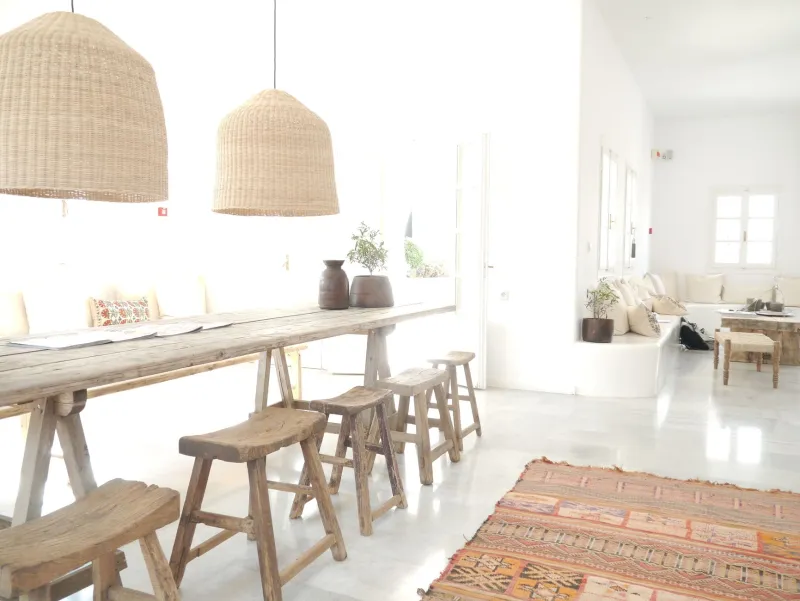
Texture contrast is among the most reliably successful layering strategies. A smooth, flatwoven jute beneath a high-pile Moroccan Beni Ouarain creates a tactile richness that reads immediately as intentional. Similarly, a tightly woven wool kilim beneath a loosely knotted tribal rug introduces a dimensional quality that neither rug would achieve alone.
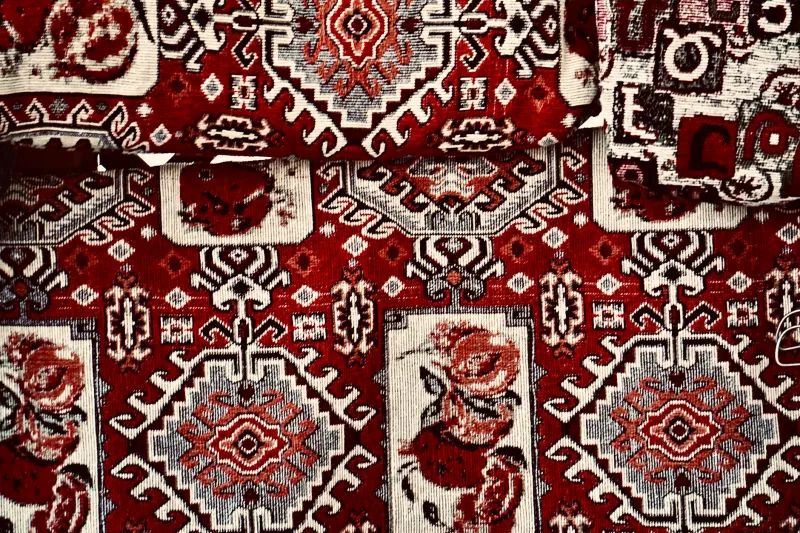
Pattern contrast, when handled carefully, produces some of the most visually dynamic results. The key is to avoid pairing two rugs of equal visual complexity at the same scale. A densely patterned foundation will overwhelm almost any top rug. A subtly textured or geometric foundation, however, can support a boldly patterned topper without the combination becoming chaotic. Contemporary designers working in cities like Chicago, Los Angeles, and New York have demonstrated considerable creativity in pairing abstract modern prints with vintage traditional patterns—an approach that signals confidence and a willingness to treat design as a personal language rather than a set of rules to be followed.
What to Avoid: The Layering Mistakes That Create Visual Noise
For all its creative potential, rug layering is not without its pitfalls. The most common errors are worth naming directly.
Matching color families too closely is perhaps the most frequent misstep. When the foundation and top rug share nearly identical tones, the layering effect disappears and the result simply looks like an odd sizing choice. The top rug should introduce something the foundation does not already offer—whether that is a contrasting hue, a different value, or a more saturated accent color.
Layering two rugs of similar pile height tends to produce a visually muddled result. Without textural differentiation, the eye has no clear way to distinguish the two layers, and the combination reads as confusion rather than intention.
Centering the top rug symmetrically on the foundation at all times can make the arrangement feel overly formal and static. Many of the most successful layered floors feature the top rug positioned slightly off-center or angled subtly—a choice that introduces a sense of casual confidence and suggests the room has evolved organically rather than been staged.
Layering in Practice: Three Room Scenarios
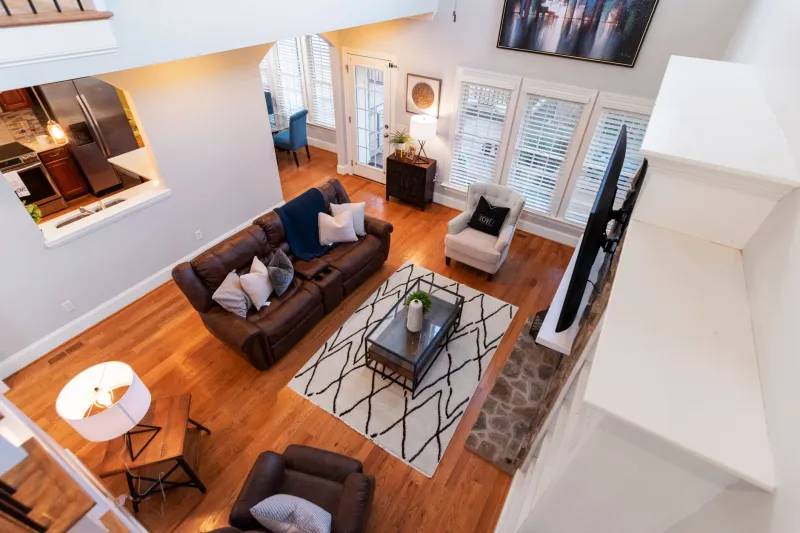
In a living room, begin with a 9×12 natural jute in warm flax. Layer a 5×8 vintage Oushak in ivory, rust, and soft blue off-center beneath the coffee table. The organic irregularity of the antique pile against the structured weave of the jute creates immediate depth.
In a primary bedroom, anchor the bed with a 10×14 low-pile wool in charcoal. Layer a 6×9 Moroccan shag in cream at the foot of the bed, extending far enough to be felt underfoot when rising in the morning. The contrast between the structured wool and the soft shag is both visual and tactile.
In a home office, place a flatwoven kilim in muted terracotta and navy across the full working area. Add a small sheepskin or cowhide beneath the desk chair—a layer that is functional, visually distinctive, and easily removed.
A Note on Commitment
Rug layering rewards commitment. Half-hearted attempts—a small topper barely distinguishable from the floor beneath it, or a combination chosen without regard for contrast—tend to look unresolved rather than deliberate. The approach works precisely because it signals that someone has thought carefully about what the floor should communicate. Approached with that level of intention, it remains one of the most expressive and adaptable tools available to the contemporary American home.