Designed to Disobey: Why the Best Rug Choices Ignore Conventional Wisdom
Every interior designer has encountered the list. It circulates through trade publications, Pinterest boards, and well-meaning showroom consultants with the gravity of architectural code. Your rug must anchor all major furniture legs. It must echo the room's dominant color. It must never be smaller than the sofa. Never mix patterns. Always layer with intention.
And yet some of the most arresting interiors in American homes—from Brooklyn brownstones to Austin bungalows to Seattle loft conversions—achieve their power precisely by ignoring these edicts. The question worth asking is not whether rules exist, but whether they deserve the authority we grant them.
Where the Rules Come From
Design rules are rarely arbitrary. Most originate from sound spatial logic. The instruction to size a rug so that all primary seating furniture rests at least partially on it, for instance, exists to visually unify a conversation area and prevent the floating-furniture problem that plagues so many living rooms. The advice to pull rug color from an existing anchor piece—a sofa, a drapery panel, an architectural feature—offers a reliable method for achieving cohesion when a homeowner is uncertain.
The difficulty arises when these heuristics calcify into absolutes. A principle designed to prevent a common mistake becomes a prohibition against a deliberate choice. Rules that were meant to guide the uncertain end up constraining the confident.
Understanding why a rule exists is the first step toward knowing when breaking it is not a mistake but a statement.
The Matching Fallacy
Perhaps no rug rule is more persistently repeated than the instruction to match your rug selection to your largest or most prominent furniture piece. The logic is tidy: repetition creates harmony, and a rug that mirrors the sofa's tone or the dining chairs' finish will feel intentional.
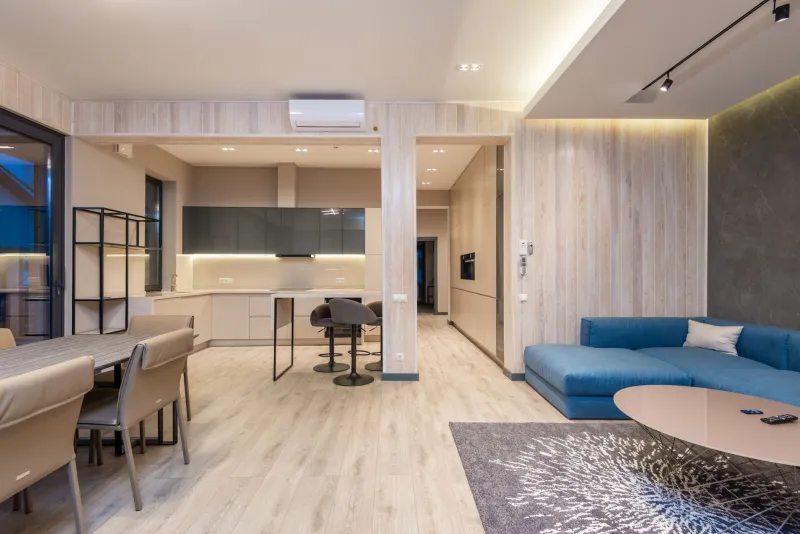
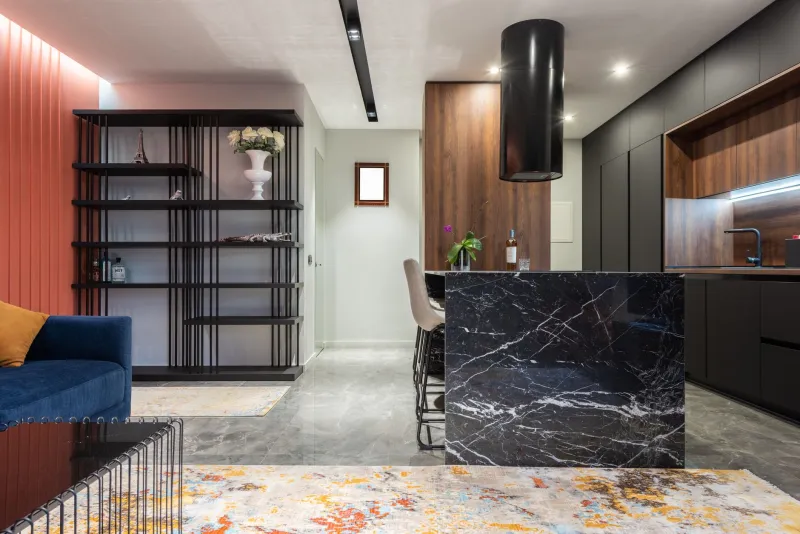
But consider what this approach sacrifices. A room where every element agrees is a room without tension—and tension, wielded thoughtfully, is what gives a space visual energy. Some of the most memorable living rooms in American interior design feature rugs that actively contrast with their surroundings. A warm, terracotta-toned Moroccan flatweave beneath a cool gray sectional creates a conversation between elements. A deep navy wool rug under a room of natural linens and pale oak furniture announces itself as the room's punctuation mark rather than its footnote.
The real principle at work in successful contrasting pairings is not chaos but intentionality. The rug that diverges from its surroundings must do so with confidence and coherence. It should feel chosen, not stranded.
The Layering Mandate (And When to Refuse It)
Layered rugs have dominated interior design media for the better part of a decade. The visual of a natural jute or sisal base rug beneath a smaller, patterned textile has become so ubiquitous that it now risks reading as a shortcut rather than a considered decision.
Layering serves genuine purposes. It adds depth to minimalist rooms, introduces pattern without full commitment, and allows a budget-conscious homeowner to extend the visual coverage of a smaller statement rug. In the right context, it remains a powerful tool.
But the mandate to always layer—to treat a single rug as somehow incomplete—misunderstands what a singular, well-chosen rug can accomplish. A large-scale, beautifully patterned rug in a clean, uncluttered room often gains its full power from being seen whole and uninterrupted. Placing a second rug on top fragments that power. It introduces a visual conversation the room never needed to have.
The question to ask is not whether a room can accommodate a layer, but whether it benefits from one.
The Sizing Orthodoxy
The instruction to always size up—to err on the side of a larger rug rather than a smaller one—has genuine merit as a default position. Undersized rugs are among the most common design errors in American homes, and the advice to go larger has rescued countless awkwardly proportioned rooms.
Yet the opposite choice, deployed deliberately, can produce remarkable results. A compact rug centered beneath a coffee table in a large, open living room creates an intimate island within a generous space—a designed moment of compression that makes the surrounding openness feel more intentional, not less. In a dining room with a dramatic floor surface, a purposefully smaller rug that frames only the table base rather than extending beneath all chair legs can draw attention to the floor itself as an architectural feature.
Size is not simply a matter of coverage. It is a compositional decision about where the eye travels and what the room chooses to emphasize.
A Framework for Productive Rule-Breaking
None of this is an argument for abandoning guidance altogether. It is an argument for interrogating it. Before accepting any design rule as binding, consider three questions.
First, what problem does this rule solve? If you do not have that problem, the rule may not apply to your space. A room with exceptional natural light and a clearly defined conversation area may not need a rug that anchors all furniture legs, because the architecture has already done that work.
Second, what does following this rule cost you? Every design decision involves trade-offs. If adherence to a conventional sizing guideline means sacrificing a rug whose color or pattern genuinely moves you, the calculus deserves examination.
Third, is your deviation purposeful or accidental? The difference between a rule broken by a skilled designer and a rule broken by an inattentive one is usually legible in the finished room. Purposeful deviation reads as a point of view. Accidental deviation reads as an oversight. The question to ask of any unconventional choice is whether it creates something the conventional choice would not.
Trust the Room, Not the Doctrine
Design rules offer a useful vocabulary for spaces that are still finding their voice. They provide a reliable path from confusion to coherence. But they are a starting point, not a destination.
The most compelling rooms in American homes—the ones that stay with you after you have left them—are almost never rooms that followed every instruction. They are rooms where someone looked at the conventional answer and asked whether it was also the right answer. Sometimes it was. Often, it was not.
The rug beneath your feet is one of the most powerful instruments available for shaping how a room feels, moves, and speaks. Using it well sometimes means following the rules. Using it brilliantly sometimes means knowing exactly which ones to leave behind.