Start With the Rug: How Professional Designers Build Entire Rooms From the Floor Up
There is a persistent assumption in American home décor culture that paint comes first. You select a wall color, purchase a sofa to complement it, then shop for accent pieces that pull the look together. The rug, in this conventional sequence, arrives last—a finishing gesture rather than a guiding principle. It is, frankly, one of the most common and costly mistakes a homeowner can make.
Professional interior designers largely operate in the opposite direction. For many practitioners, the rug is not the final punctuation of a room's story; it is the opening sentence. The logic, once understood, is both elegant and practical—and it has the potential to fundamentally change the quality of every design decision that follows.
Why the Rug Contains More Information Than Any Other Element
Consider what a single well-crafted rug actually holds: a palette of two, five, sometimes a dozen colors; a texture that implies a level of formality; a pattern scale that communicates something about the room's intended energy; a cultural lineage that suggests a broader design vocabulary. No other furnishing in a room carries this density of visual data.
A sofa is, at its core, a field of one color and one texture. A painted wall is even more singular. But a Persian Heriz, a Moroccan Beni Ourain, a hand-knotted Oushak, or a contemporary flatweave from a domestic studio—each of these objects contains an entire design argument within its borders. When a designer chooses the rug first, they are not simply selecting a floor covering. They are selecting a master key that will unlock every subsequent decision in the room.
The Color Extraction Method
One of the most practical applications of the rug-first philosophy involves what designers sometimes call color extraction—the process of pulling specific hues directly from the rug's existing palette and distributing them across the room's other surfaces and furnishings.
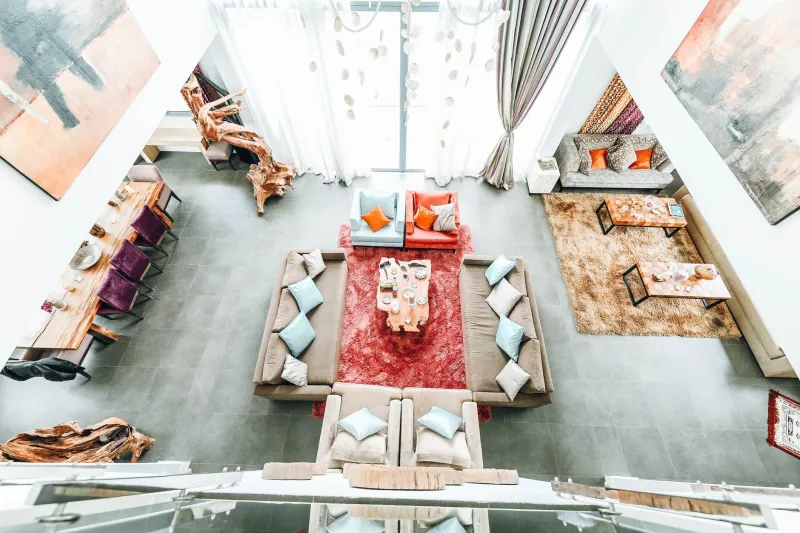
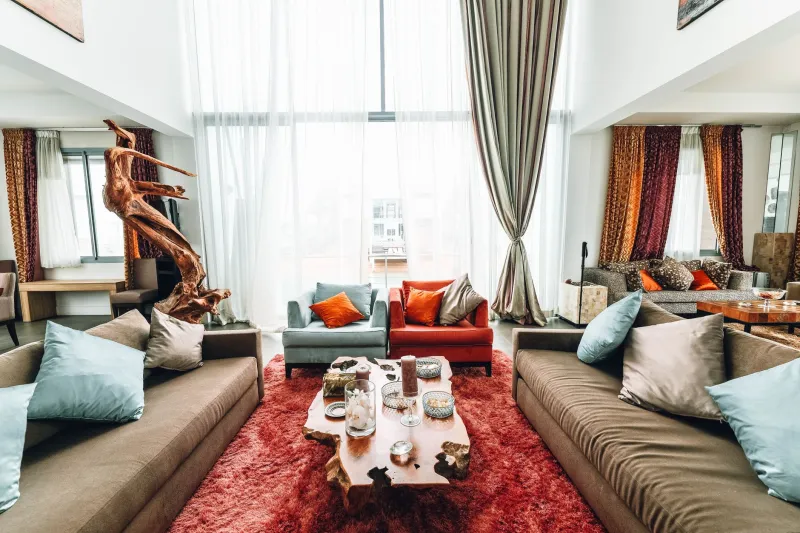
A rug with a dusty terracotta field, ivory medallion, and faded indigo border, for instance, offers a ready-made color story. The terracotta might inform the choice of a linen sofa. The indigo could reappear in throw pillows or a ceramic lamp base. The ivory becomes the natural candidate for wall paint. Nothing is invented; everything is derived. The result is a room that feels cohesive in a way that is genuinely difficult to achieve when working in the opposite direction.
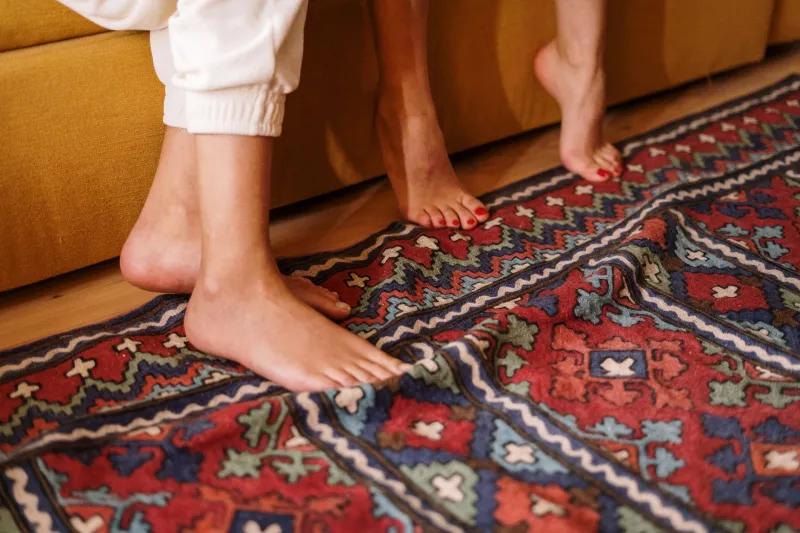
This method is particularly powerful because rugs—especially hand-knotted or hand-tufted pieces—tend to contain colors in a state of beautiful impurity. The red in a vintage Caucasian kilim is not a flat, saturated red; it is a red that has aged into something more complex, more livable. Extracting that color and applying it elsewhere in the room creates a harmony that feels earned rather than forced.
Scale, Proportion, and the Furniture Conversation
The rug-first approach also disciplines furniture selection in ways that purely visual inspiration boards cannot. When a rug is already in place—physically or in a designer's planning documents—it establishes a proportional framework that guides every subsequent purchase.
A large-scale geometric rug with bold, architectural lines will naturally call for furniture with clean profiles and visual weight to match. A delicate antique Tabriz with an intricate floral field will suggest lighter, more refined pieces that do not compete for attention. In each case, the rug is doing the work of setting the room's formal register—its level of visual complexity—before a single chair has been ordered.
This is not merely an aesthetic consideration. It is a practical one. Furniture procurement in the United States frequently involves lead times of eight to sixteen weeks for custom or semi-custom pieces. Making furniture decisions after a rug is selected—rather than simultaneously or in reverse—reduces the risk of expensive mismatches that cannot be easily corrected.
What Paint Actually Does (and When to Choose It)
The rug-first philosophy does not dismiss the importance of wall color. It simply repositions paint's role in the design sequence. Rather than functioning as the room's foundational statement, paint becomes a supporting performer—one whose job is to amplify what the rug has already established.
This shift in thinking often liberates homeowners from the paralysis of paint selection. Standing in front of hundreds of paint chips at a hardware store with no anchor is an exercise in frustration. Standing in front of those same chips with a rug's palette in hand is an entirely different experience. The field narrows immediately and decisively. The right choices become obvious in a way they simply cannot be without that reference point.
Many designers recommend bringing a photograph of the selected rug—or better, a physical sample—to the paint store rather than relying on memory. The eye is notoriously unreliable when asked to match colors across time and lighting conditions.
Lighting Follows the Rug as Well
An often-overlooked dimension of the rug-first method is its influence on lighting design. The texture and tone of a rug have a direct relationship with how light should be distributed in a room. A high-pile wool rug in warm, earthy tones will absorb ambient light and create a sense of intimacy; the room will benefit from layered lighting sources rather than a single overhead fixture. A flatweave kilim in bright, high-contrast colors will reflect light differently, tolerating—and even requiring—more direct illumination to reveal its pattern fully.
Lighting decisions made without reference to the rug can inadvertently undermine a room's entire atmosphere. Designers who begin with the rug are already thinking about these relationships before the first light fixture is specified.
A Practical Invitation
For homeowners embarking on a room renovation or refresh, the rug-first method offers something beyond better design outcomes: it offers clarity. The decision fatigue that accompanies large interior projects is real and significant. Every choice that can be derived from an earlier, more fundamental choice reduces that fatigue and increases the likelihood that the finished room will feel intentional.
Begin with a rug that genuinely moves you—one whose colors, texture, and character speak to the life you want to live in the space. Then let it lead. The walls, the furniture, the lighting, the accessories: allow each to answer to the rug rather than to an abstract vision board or a trend report. The result will be a room that feels not merely decorated, but deeply considered—grounded, in every sense of the word, from the floor up.